






























This whole city block got an indigenous redesign

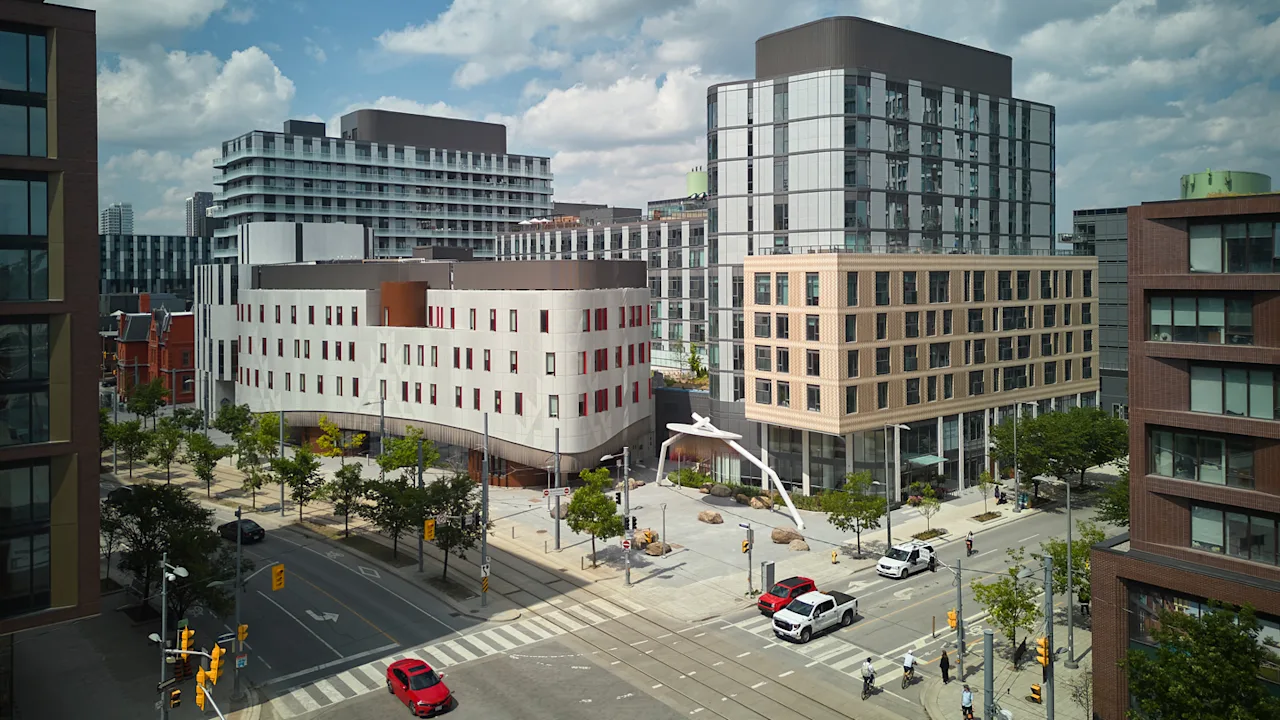
The metallic fringe hanging down from the edge of Anishnawbe Health Toronto’s community health center near downtown Toronto is the biggest indication that something different is happening here.
Created to provide centralized health care and traditional healing to the 90,000-strong Indigenous population of Toronto, the clinic is the centerpiece of a unique city block of development that was intentionally led by the Indigenous community and designed to reflect its culture.
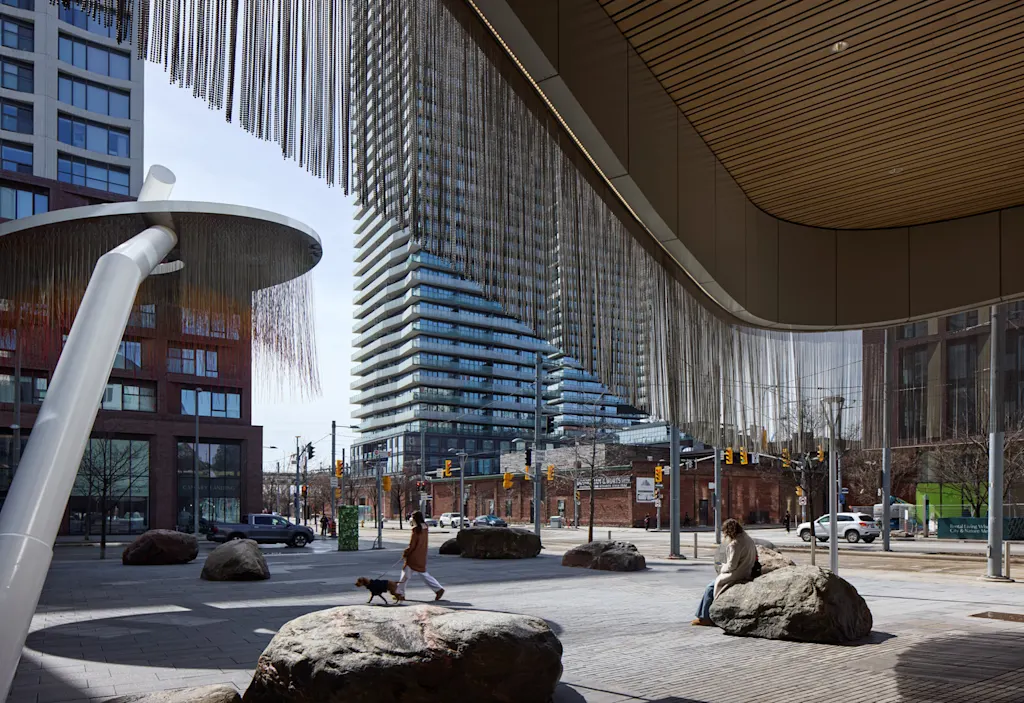
The wraparound fringe of more than 12,000 strands of stainless steel chain—the kind of aesthetic flourish easily targeted for elimination by the value engineers of a typical development—is just one of many elements of the project that put its Indigenous roots on full display on this block.
From its services and its building forms to the orientation of its landscaping, the development embodies Indigenous traditions, practices, and principles in a way that’s wholly uncommon in most urban environments.
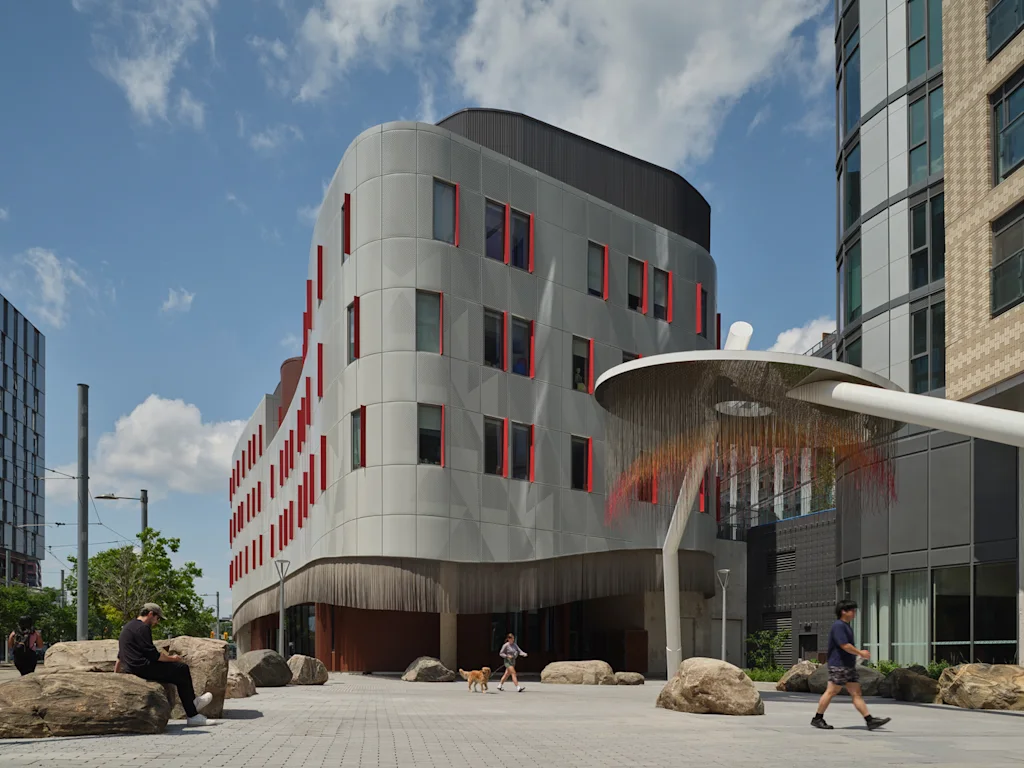
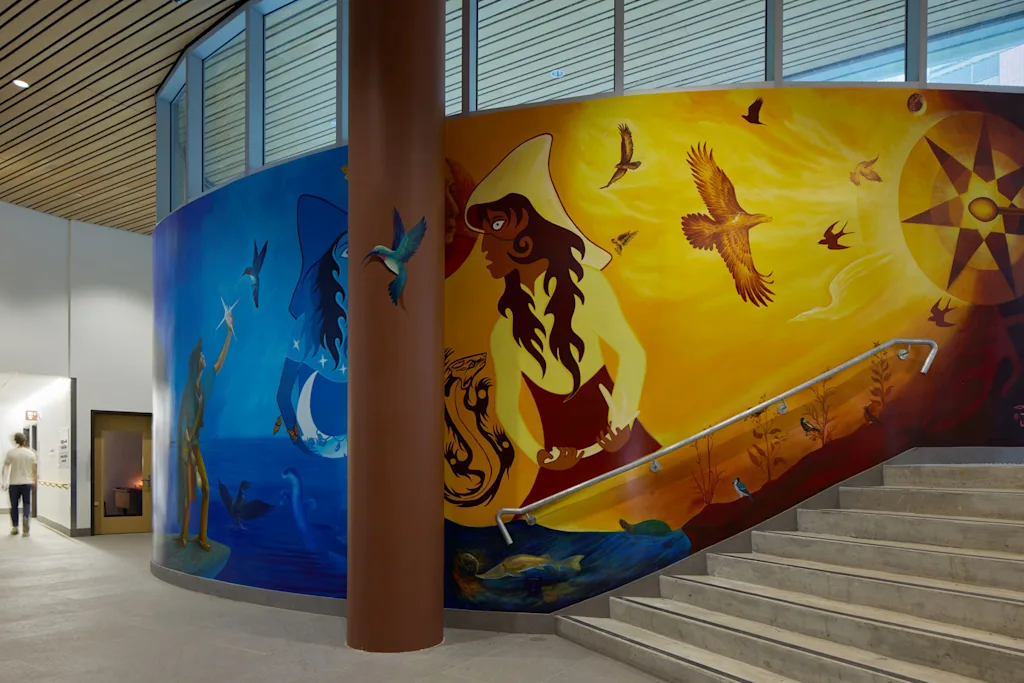
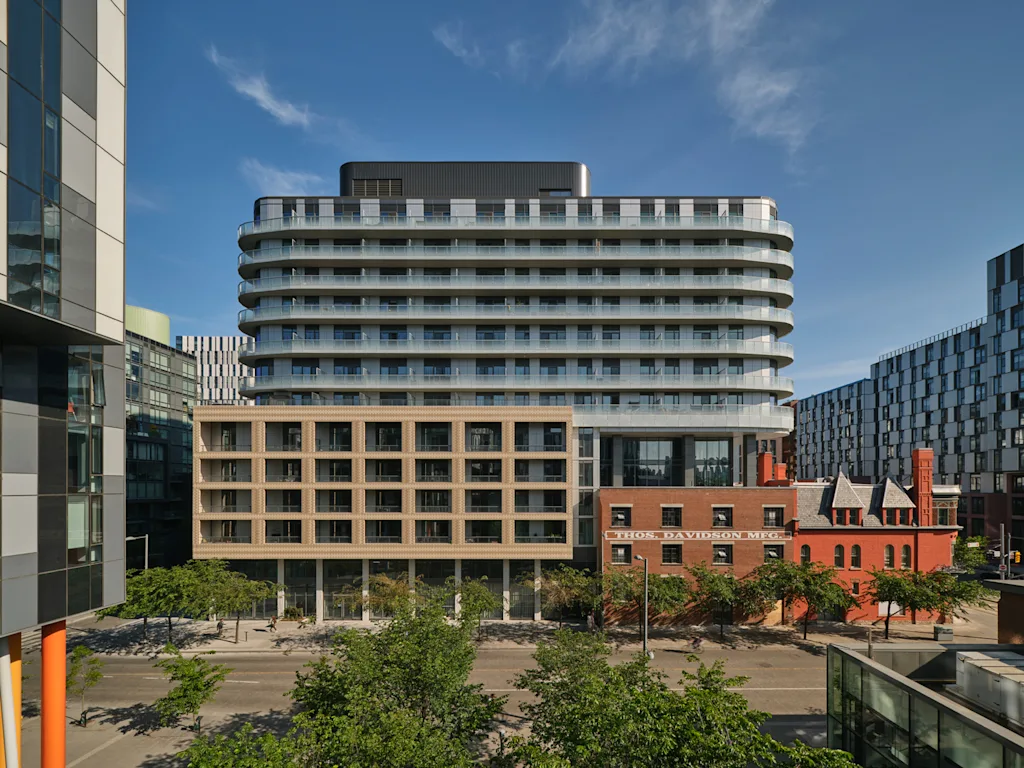
Named the Indigenous Hub, this city block of development includes the aforementioned health center, along with an Indigenous job training center, two mid-rise residential towers, and public and private plazas. Indigenous iconography and material references can be seen across the site, from building facades that reference sacred blanket designs and healing rituals to wall treatments that evoke the bark of trees that once stood as forests on this site.
It’s a project that goes to unusual lengths to put these elements on display. And it also required everyone involved in the project, from the developer to the architects and the landscape designers, to rethink their approach to urban development.
‘A place of indigeneity’
Located in a part of the city that was once the floodplain of the Don River, and before that the ancestral lands and hunting grounds for Indigenous people for thousands of years, the site holds deep resonance for the community. The designers of the project, including an Indigenous architecture firm headquartered in a nearby First Nation, put great effort into drawing those connections in the look and feel of the project.
“The intent was all about how do we ensure that when people are in this block, they understand that it is a place of indigeneity, and also understand where they are within the city,” says Matthew Hickey, a partner at Two Row Architect, an Indigenous architecture firm that advised on the design of every part of the project.
Working closely with Stantec Architecture, Two Row helped create the plan for the block, and then worked alongside Stantec and the architecture firm BDP Quadrangle to guide the design of the buildings and outdoor spaces within the block, including building facades inspired by traditional dress, traditional healing spaces that connect directly to the earth, and a central Indigenous Peoples Garden plaza where medicinal plants are grown.
This ambitious, Indigenous-led development has been decades in the making. The charity health care organization Anishnawbe Health Toronto (AHT) had been searching for a place to consolidate and improve services it had been providing to Toronto’s Indigenous population since the 1980s. Then in the late 2000s, when officials in Toronto put in a bid to host the 2015 Pan Am Games, this former floodplain was targeted as a potential site for redevelopment. As part of the plan, and in line with Canada’s Truth and Reconciliation Commission Calls to Action, a two-and-a-half acre section of the redevelopment area was set aside for Indigenous uses.
AHT was chosen to use this land as a centralized location for its services, with funding from the Ministry of Health. After some complex negotiations at the provincial level, the project was expanded to build an entire city block of development.
The project soon took on the name Indigenous Hub. Joe Hester, the longtime executive director at AHT who died in early 2025, stressed to the design teams that the land wasn’t being granted to the Indigenous community but returned to them. Rather than designing a development that would simply blend into the urban surroundings, the project represented an opportunity to make a mark.
“It’s the first time a health center has been built across Canada specifically to house and to care for Indigenous people, which is shocking on one hand, but also amazing on the other,” says Hickey.
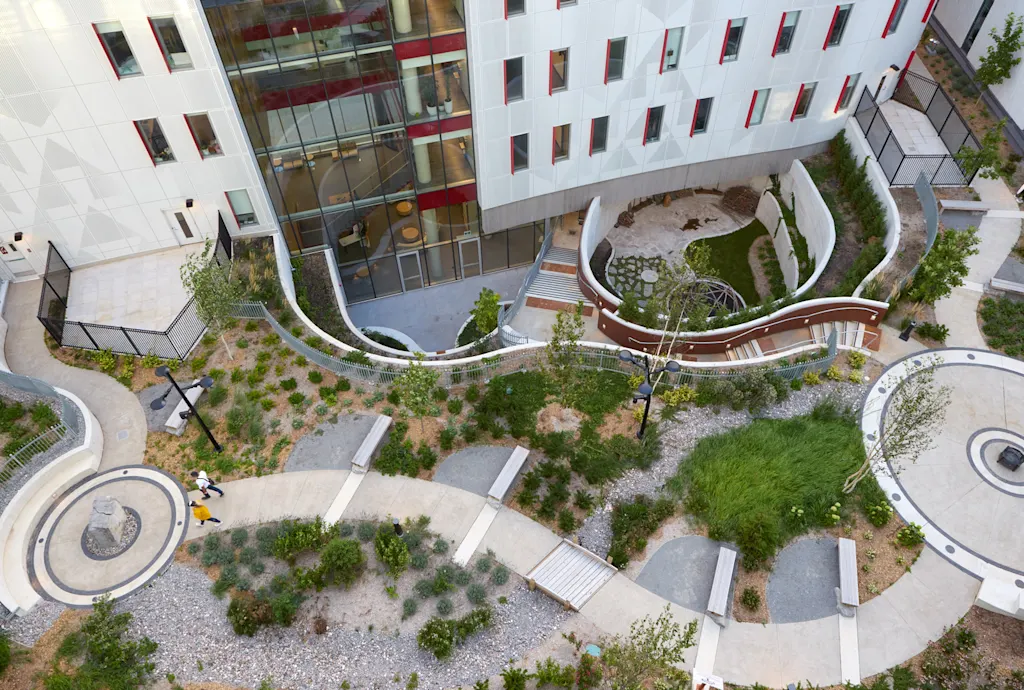
At the prodding of Hester and AHT, the project’s designers were called on to design a piece of the city that called attention to its Indigenous character, and prodded people to think about Indigenous people and practices. “We were all very conscious that we were working in a different place with different terms of reference and we needed to be sensitive to those things at all times,” says Les Klein, BDP Quadrangle cofounder.
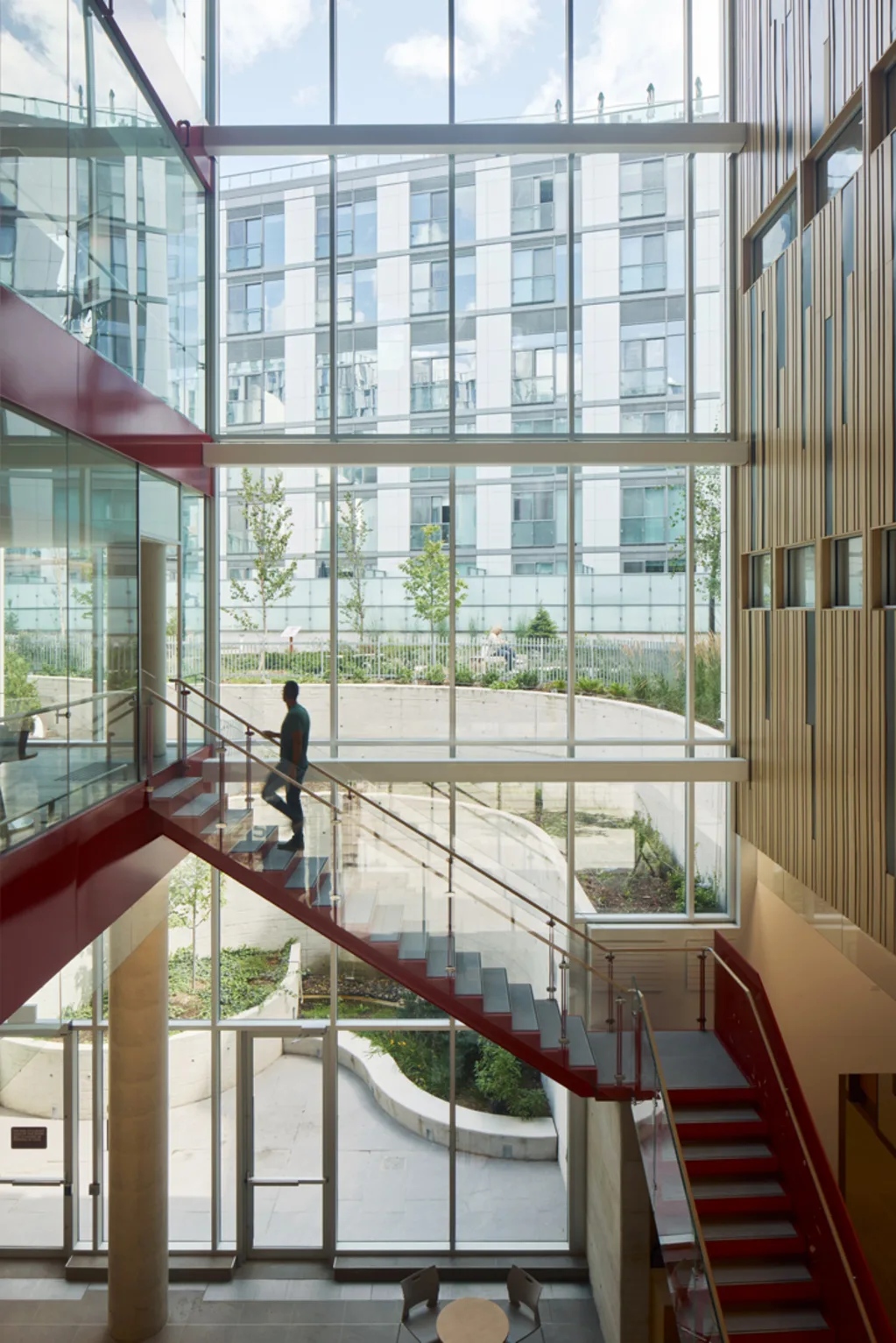
The designers considered the project as a landscape first, the oriented the buildings around what became the Indigenous Peoples Garden. “It forms a central amenity and organizing element for the whole block,” says Michael Moxam, project design principal and design culture practice leader for Stantec.
The buildings make visual connections to this central space from the street and from within the health center. “In our work in healthcare, we’re always so focused on the health impact of a connection to landscape and the health impact of a connection to natural light and views. That gets right back to the idea of thinking about the whole block as a landscape first,” says Moxam. “There’s indigenous cultural value to that, but there’s also just a health and wellness value to that.”
People over parking
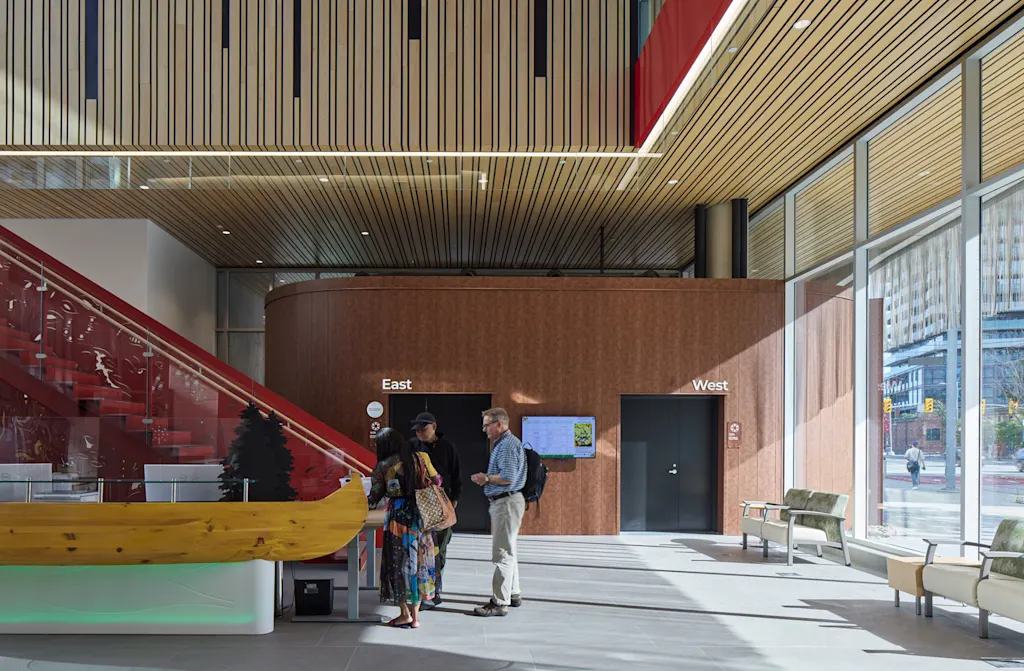
Some compromises had to be made. The placement of the health center within the block meant that its entrance was in an undesirable location, according to Indigenous principles. “The building entry is on the west side, which we never enter buildings on. It’s the side of death, basically, with the east side being the side of birth,” Hickey says. As a workaround the design team added a three-story atrium to the east side of the health center, facing the central garden. “Orienting the atrium to the rising sun was one of the teachings that’s embedded in there,” Hickey says.
The designers even tweaked the building facades surrounding the central garden to reflect more light into that east-facing atrium. “We would not have done that if we hadn’t been talking about it and understanding how important those elements are,” Klein says.
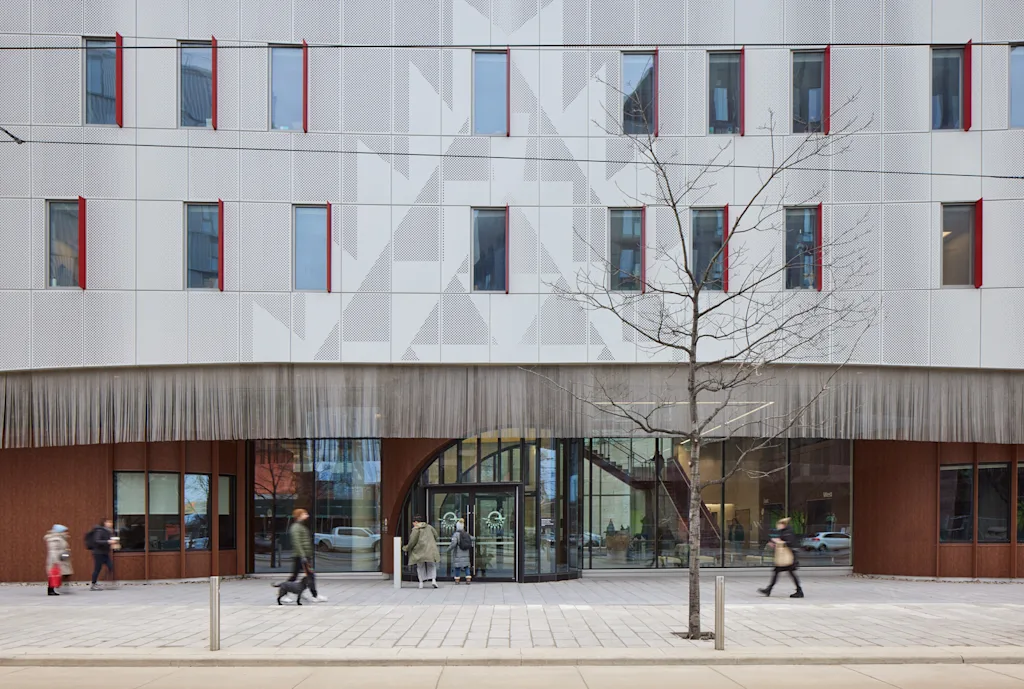
This level of intention helped make the health center building so striking. In addition to its metal fringe, the facade is clad in perforated aluminum that’s patterned after a star blanket, which symbolizes connections with ancestors and the cosmos. Inside, conventional clinical spaces are situated alongside traditional healing spaces on each of the clinic’s four floors, with curving rusted steel appearing at the street level to indicate where these spaces are located.
In line with an Indigenous principle that healing spaces be in direct contact with the earth, the block’s plan was altered to move all underground parking and basement space outside the footprint of the health center to sit beneath the two housing towers on the block’s edge. “We went to [Hester] and said, you know, it’s going to lose a few parking spaces. And he said, ‘this is what we’re going to do,'” Klein says. “Things that I would normally at least be nervous about going to a developer to talk about just became part of the natural conversation.”
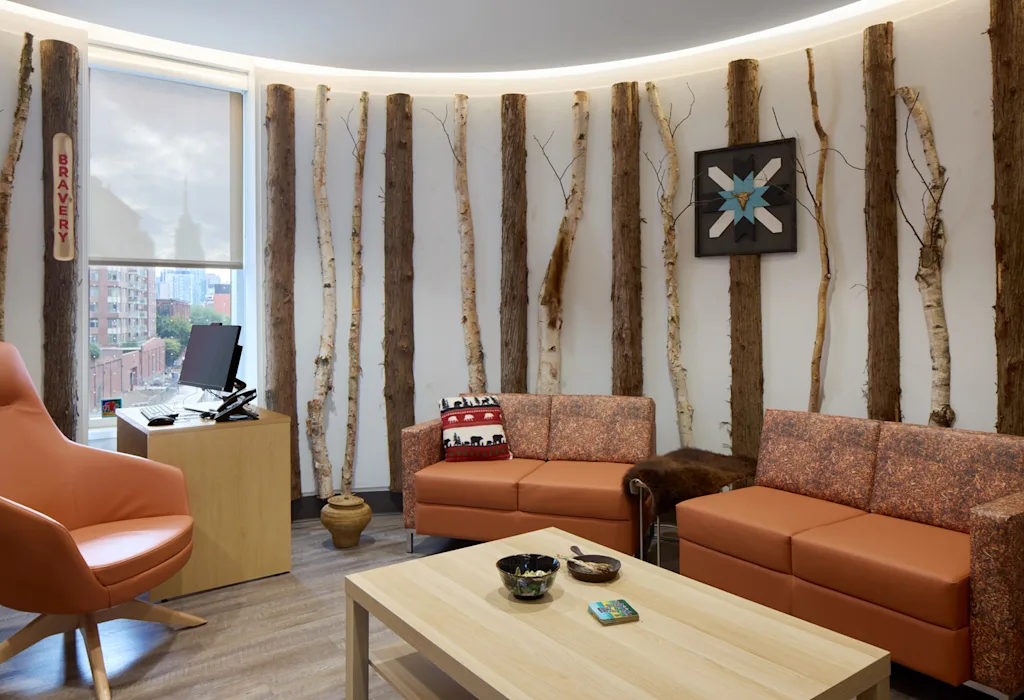
Building materials make other references across the development, including multi-colored bricks that mimic the form of a woven basket, and precast concrete panels patterned after the bark of native birch trees.
The fringe around the health center is perhaps the most meaningful design choice, and most representative of what makes this development so unique. It’s inspired by the shawls used by fancy dancers at Indigenous powwows, and also by the sound made by the jingle dresses traditionally used during healing rituals.
“For a jingle dress dancer, it’s about healing. They dance for people to heal, and that sound is a part of it,” says Hickey. “For us, dancing is not just for dancing or showing off. Like architecture is not about showing off. It’s about what it’s doing.”