
Gordon Ritter: who owns the intelligence economy?
 Tomas Kauer

The rules governing the AI economy are being written by default.
Back in June, I argued that the AI doomers are incorrectly counting jobs when they should be counting traces. Traces are what people leave behind on every system they touch: corrections, judgment calls, reasoning that closed the deal, workarounds not found in a manual. They are among a company’s most valuable assets. So, who owns them?
No one has decided yet, and that window won’t stay open long. Take the growth of radio in the 1920s. American broadcasters staked out radio frequencies faster than the law could follow. By the time Congress passed the Radio Act of 1927, control had already solidified. The Communications Act of 1934 ratified it.
Radio was a bureaucratic battle about who owned the airwaves. The resource today is human intelligence: how people reason, decide, and create. If we treat it as something to extract rather than cultivate, we drain the source every future breakthrough depends on.
Companies building AI on employees’ work stake a claim about who owns what a system learns. If we don’t shape the rules now, the companies controlling the most powerful models will set the terms, and everyone else will pay rent.
Here is a starting point, a social contract for the intelligence economy with three layers: platform, organization, and individual.
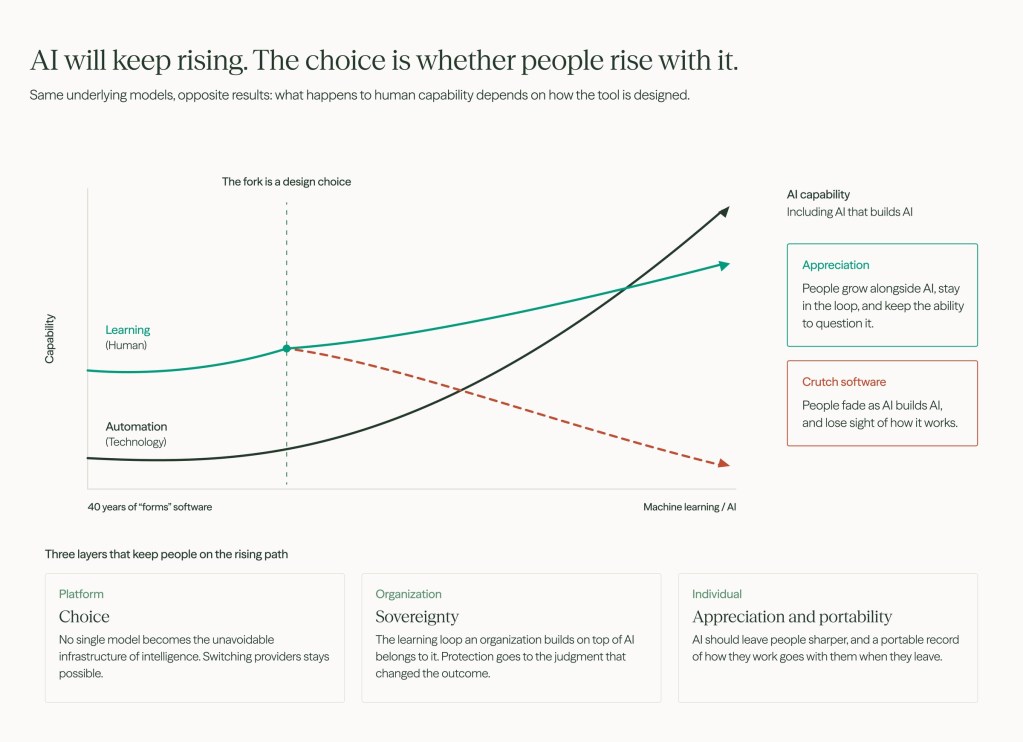
At the platform level: choice. No single model should become the unavoidable infrastructure of intelligence. As foundation model capabilities converge, the durable advantage remains above the model, living in the learning loop an organization builds on top of whichever model it runs.
Providers make switching costly, often binding organizations to the first model they adopted. Access to AI should not require surrendering intelligence as a condition of service.
At the organization level: sovereignty. The learning loops, workflows, and domain expertise organizations build on top of AI belong to organizations.
Human expertise is already being turned into training data for AI: RedCompass Labs trains its Payment Expert Agent with Cognitive Task Analysis (CTA), turning thousands of hours of expert work into datasets that teach AI how specialists’ reason and make decisions.
Employees who use public AI tools at work are teaching an external agent how the organization operates, one of the most valuable things a model can learn. Enterprise contracts often prohibit training on internal data, but protections around behavioral traces and process knowledge are far less settled.
Not every workflow deserves the same protection. Routine operations can stay transparent by default. The outliers are another story: the rep who ignores the script and closes the deal anyway, the engineer’s fix that isn’t in any runbook. That’s the generative part of the loop, and sovereignty claims belong with the judgment that changed the outcome.
At the individual level: appreciation. I mean the word the way an investor does. A person’s judgment should be worth more when they leave a job than when they arrived. Models get smarter by learning from human judgment. Do humans get smarter too? What does each side keep when the relationship ends? This is the least settled layer.
AI can become crutch software, which hands over answers without asking the user to judge accuracy, quality, or offer improvements. In one study, undergraduates who used ChatGPT as a study aid scored significantly lower on a surprise retention test 45 days later than students who stuck with traditional study methods. The tool gave correct answers but removed the recall that makes learning sticky.
But a crutch is a design choice. In a separate study, Harvard researchers tested an AI tutor that withheld answers until students reasoned their way to them. These students achieved more learning gains on tests right after the lessons and spent less time than peers in an active-learning classroom. This study doesn’t establish long-term retention, but it showed how AI can be designed to support learning.
I believe technology should make people better at their work. This is the next layer of our 2017 Coaching Networks thesis. The first generation collects and spreads top performers’ moves to everyone else. The next generation must help people invent new moves, and that requires friction. Without it, workers atrophy as AI ascends.
People should also leave their roles with more than they brought in. A doctor leaves a hospital, and they take their clinical judgment. The hospital keeps patient records and protocols. AI blurs that line by capturing both a person’s output and the approach.
A “cognitive passport” could restore it: a portable, anonymized record of how a person approaches problems, excluding deals, documents, and confidential processes. The company keeps what it learned. The person keeps their judgment. That portability gives people a reason to keep growing and contributing, and companies that support it will recruit against companies that don’t.
Consider an enterprise sales representative moving on from her role. Over four years, her company’s AI watched thousands of her calls and every deal she closed. It learned the company’s pricing and how she handles negotiations, which accounts were in play, and when she brings in senior leaders. It saw how she opens with a question about the buyer’s last quarter instead of leading with the product, how she slows down when a CFO joins, and how she drops the script entirely with technical buyers. It then coaches the rest of the team using her moves.
When she leaves, the calls, records, lead lists, customers, deal details, and pricing stay with the business. So does the coaching model, including everything it learned from her.
Her passport records her patterns and the shape of her work, like when she departs from the script or the moments she overrode the system and was right. Her habit of opening with a question about the buyer’s last quarter is hers. Her company’s 18 percent discount floor is not. The passport is generated by the system that holds the data, cleared by the employer against a confidentiality review, and judged by whoever hires her next, like a portfolio. What doesn’t exist yet is a common format that would make a passport from one company mean something at the next.
The temptation now is to use AI to reduce human work. This is the wrong target. The goal should be to make human thinking more powerful, durable, and portable. People will keep working. The question is whether the intelligence they generate compounds in their favor or flows to a platform they don’t control.
It is early enough that the answer is still a choice. A McKinsey study found that while 89% of organizations are using AI in at least one business function, only 44% started to scale it. That is exactly the window where a genuine-choice principle has the most impact.
To be clear where I sit: Emergence Capital is a venture firm, and we make money when the companies we back become more valuable. But more than twenty years in enterprise software have taught me that technology creates the most value when the people whose thinking feeds it trusts the system.
This framework needs stress-testing from founders, researchers, legal scholars and labor voices, and I expect to be wrong about parts of it.
Humans are the only mutation engine in the age of AI. AI can master any game with fixed rules. Markets keep changing the rules, and people are the first to see the new game. The people whose judgment trains today’s AI systems should be treated as co-authors, not raw material.
The opinions expressed in Fortune.com commentary pieces are solely the views of their authors and do not necessarily reflect the opinions and beliefs of Fortune.
This story was originally featured on Fortune.com